The 2026 Pivot: Why the Nigerian Real Estate Outlook is Changing
 SM
SM
Nigeria's housing crisis isn't a forecast — it's a present-tense emergency reshaping where and how wealth gets built. The Federal Ministry of Housing and Urban Development officially pegged the national housing deficit at 14.925 million units as of early 2026. That number isn't just a statistic. It's a structural signal — one that smart capital is already responding to.
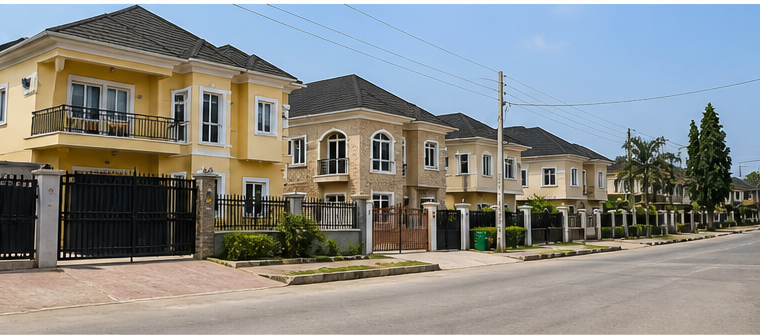
The future of real estate in Nigeria (2026–2030) isn't being written in glass towers. It's being written in functional, affordable, infrastructure-connected suburbs that actually work.
For years, the investment narrative defaulted to luxury developments in congested city cores. That model is losing its edge. Rising land costs, unreliable utilities, and gridlocked infrastructure are compressing returns in traditional hotspots. Meanwhile, a parallel story is gaining momentum: suburban corridors powered by renewable energy, anchored by new infrastructure, and increasingly supported by PropTech adoption in Nigeria that makes remote buying, digital title verification, and virtual site tours genuinely viable.
The 2026–2030 window represents something rare — a convergence of demand pressure, policy shifts, and infrastructure investment that's redirecting serious money toward entirely new geographies. Understanding where that geography begins requires a closer look at which corridors are being built, and why.
The New Geography of Wealth: Infrastructure-Linked Urban Expansion
Urban expansion trends in Nigeria are being redrawn — not by city planners, but by infrastructure investment and the hard math of ROI. Traditional urban cores like Lagos Island and Abuja's Central Business District are losing their investment edge fast. Grid failures, traffic congestion, and land saturation have compressed yield potential in these once-dominant zones. Smart capital is moving outward.
Factor | Traditional Core | Infrastructure-Linked Suburb |
|---|---|---|
Appreciation Rate | 5–10% annually | 15–30%+ annually |
Infrastructure Reliability | Aging, congested | New builds, planned |
Land Availability | Scarce, overpriced | Accessible, scalable |
ROI Timeline | Long, uncertain | Shorter, demand-driven |
Primary Value Driver | Legacy prestige | Port, rail, road access |
Lagos: The Lekki-Epe Corridor and Sangotedo
The most compelling story in Lagos real estate right now is happening east of the island. According to Thinkmint Nigeria's REDA 2025 Insights, the Lekki-Epe corridor is experiencing property appreciation rates 2–5x faster than traditional urban cores. Epe and Sangotedo have emerged as genuine investment frontiers, powered by proximity to the Lekki Deep-Sea Port — a transformational piece of infrastructure that will anchor commercial and residential demand for decades, according to Blue Dutch Property.
Infrastructure proximity is now the most reliable pricing signal in Nigerian real estate.
Abuja: Lugbe, Kuje, and the Mini-City Blueprint
Abuja's expansion follows a parallel logic. Satellite communities like Lugbe and Kuje are being repositioned as self-contained mini-cities. Planned road networks, district-level commercial hubs, and affordable land prices relative to Maitama or Asokoro make these zones high-yield opportunities for investors building over a three-to-five-year horizon. What was once considered a peripheral purchase is now a calculated move.
Emerging Cities: Beyond Lagos and Abuja
Port Harcourt's Trans-Amadi corridor and Ibadan's Monatan axis are following the same pattern. Rail expansion proposals and industrial zone designations are pre-pricing land values ahead of completion — rewarding early movers disproportionately.
Understanding where these shifts are happening is one side of the equation. Understanding how technology is accelerating those shifts — that's where the next layer of opportunity lives.
PropTech 2.0: AI and the Smart Housing Revolution
The infrastructure story covered in the previous section only holds up if the technology exists to support it. Increasingly, it does — and tech in real estate Nigeria is no longer a niche conversation. It's becoming the operational backbone of how properties are built, priced, managed, and sold.
The scale of this shift is hard to ignore. The Nigerian PropTech sector now counts over 200 active startups — spanning digital listings, construction tech, mortgage facilitation, and tenant management platforms. That's not incremental growth. That's an industry rebuilding itself from the ground up, in real time.
The most consequential development isn't the apps. It's the intelligence behind them. AI-powered valuation tools are reaching up to 90% accuracy in pricing residential and commercial assets, dramatically reducing the guesswork that has historically made Nigerian property investments risky for first-time buyers and international investors alike. Reliable valuations mean faster transactions, better financing terms, and more confident capital allocation.
On the management side, the numbers are equally compelling. According to Ken Research data via Nigeria Real Estate Blog, AI integration in property management is projected to cut operational costs for landlords and developers by up to 30% by 2030. For portfolio investors managing multiple units across expanding suburban corridors, that margin difference is the gap between a profitable asset and a liability.
It's worth clarifying what "smart housing" actually means in this context — because it isn't about voice-activated light switches or luxury gadgetry. Smart housing, practically defined, is efficient resource management: predictive maintenance that flags plumbing issues before they become floods, energy monitoring systems that track consumption in real time, and automated rent collection that reduces default rates.
Tech Stack to Watch for 2026 Investors:
AI valuation and due diligence platforms
IoT-based utility monitoring integrated at the estate level
Digital mortgage and fractional ownership portals
Construction management software reducing build timelines
One pattern emerging clearly across these tools: the biggest efficiency wins aren't coming from flashy features — they're coming from eliminating waste. And nowhere is waste more costly in Nigerian real estate than in energy consumption. Which is exactly why the next frontier in smart housing isn't software alone — it's the infrastructure powering the buildings themselves.
The 'Solar-First' Mandate: Sustainability as a Competitive Edge
Energy is no longer a background concern for Nigerian property buyers — it's a deal-breaker. As Nigeria real estate investment predictions for 2026–2030 continue to mature, one variable keeps rising to the top: energy independence. Forget smart home automation for a moment. The real luxury in Nigeria right now is reliable, self-sustaining power.
"In 2026, sustainability won't be a buzzword — it will be a competitive advantage. Developers are shifting priorities to energy-efficient, power-stable communities powered by solar infrastructure." — REDA 2025 Panelists
This isn't idealism. It's financial logic.
Energy Security: The New Foundation of Property Value
Grid instability costs Nigerian households and businesses billions of naira annually in generator fuel, inverter maintenance, and lost productivity. Solar-integrated communities sidestep this entirely. Developers who've embedded solar infrastructure at the estate level — not as an add-on, but as a core utility — are delivering something no government grid connection currently can: consistency. In practice, buyers are increasingly treating energy security the same way they treat clean water access. It's non-negotiable.
Resale Value: The Coming 'Brownout Discount'
Properties without solar integration are heading toward a pricing penalty. What the market will likely call a "brownout discount" — a measurable reduction in resale value for non-solar homes — is already forming in buyer conversations. On the other hand, solar-first estates are commanding premiums that compound over time as grid dependency becomes increasingly associated with risk and cost.
Cost Savings: The Math That Closes the Deal
Traditional energy costs in Nigeria have climbed sharply alongside fuel subsidy removal. For buyers evaluating long-term affordability, a solar-equipped home isn't just comfortable — it's demonstrably cheaper to run. That cost advantage translates directly into stronger rental yields and faster resale cycles.
The energy calculus, then, is inseparable from the investment calculus — which raises the question of where exactly to deploy capital for maximum return between 2026 and 2030.
Investment Strategies for 2026–2030: Where the Smart Money Lands
With the technology and sustainability frameworks now in place, the critical question shifts to execution: how do investors translate these macro trends into tangible returns? The Nigerian real estate outlook for 2026 points clearly toward disciplined, framework-driven strategies over speculative plays.
Four Strategies That Define the Next Five Years
Anchor on high-yield rental corridors. Smart investors are focusing on high-yield rental demand in Lagos and Abuja to hedge against construction cost volatility. Suburban nodes with verified road access, stable power infrastructure, and school proximity consistently command the strongest occupancy rates and rent premiums — outperforming city-center units on net yield.
Front-load procurement to control costs. Construction materials — steel, cement, aluminum — remain volatile. Locking in supplier contracts 12–18 months ahead of groundbreaking, combined with AI-assisted project management tools, reduces exposure to mid-build price shocks significantly.
Build a pre-election hedge into your timeline. Nigeria's electoral cycles create predictable uncertainty windows. Historically, transaction volumes dip six months before a major election. Structuring acquisition timelines to close deals during these dips — when motivated sellers are more flexible — can compress entry costs by a meaningful margin.
Diversify across asset classes within target suburbs. Mixing residential, light commercial, and mixed-use formats within a single suburban development spreads risk while capturing multiple demand streams.
Investor's Corner — The 3-3-3 Rule: Before committing capital, evaluate any suburban property against three location factors (road access, power supply, proximity to employment hubs), three financial metrics (gross yield above 8%, construction cost per square meter, projected five-year appreciation), and three exit options (resale, long-term rental, institutional sale). If a property can't satisfy all three columns, it doesn't clear the bar.
These frameworks aren't theoretical — they reflect the structural shifts reshaping how capital flows across Nigeria's property landscape. Understanding where the market is heading by 2030 requires stepping back to see the full picture, which is exactly where this analysis concludes.
Key Future Of Real Estate In Nigeria (2026–2030) Takeaways
AI valuation and due diligence platforms
IoT-based utility monitoring integrated at the estate level
Digital mortgage and fractional ownership portals
Construction management software reducing build timelines
The most consequential development isn't the apps. It's the intelligence behind them.
Conclusion: Building for the 2030 Horizon
The roadmap is clear. Nigeria's real estate winners between 2026 and 2030 won't be defined by proximity to overcrowded city centers — they'll be defined by suburbs built around solar infrastructure, smart connectivity, and long-term liveability. The formula is straightforward: Suburbs + Technology + Solar = Sustainable returns.
The smart housing market Nigeria is rapidly evolving, and investors clinging to outdated, city-center-only models risk being priced out of relevance. Urban congestion, energy instability, and shifting buyer expectations have permanently altered demand patterns. Ignoring that shift isn't caution — it's a liability.
With Nigeria's real estate market projected to reach $2.4 trillion by 2026, the window for early positioning is narrowing fast.
The investors who move now — toward solar-first, infrastructure-linked suburbs — will define the next decade of Nigerian property wealth.
Ready to stay ahead of the curve? Subscribe for monthly market updates and investment insights delivered straight to your inbox.